
| U.S.S. Patriot | |
|---|---|
| |
|
Namesake: Class: Registry: Owner: Operator: Status: |
USS Patriot (MCM-7) Yorktown Class NCC-98307 United Federation of Planets Starfleet Active |
| |
| |
U.S.S. Patriot
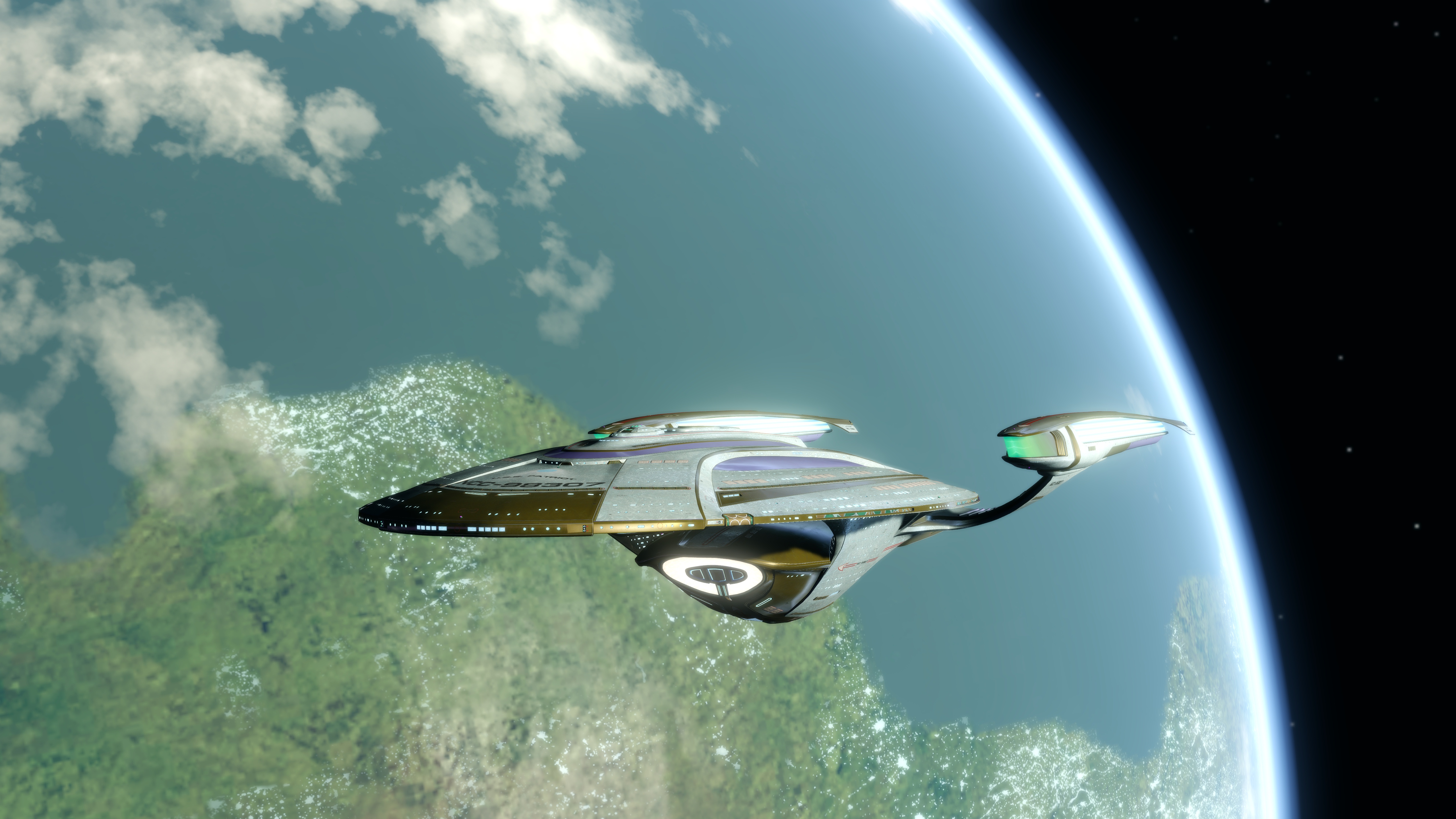
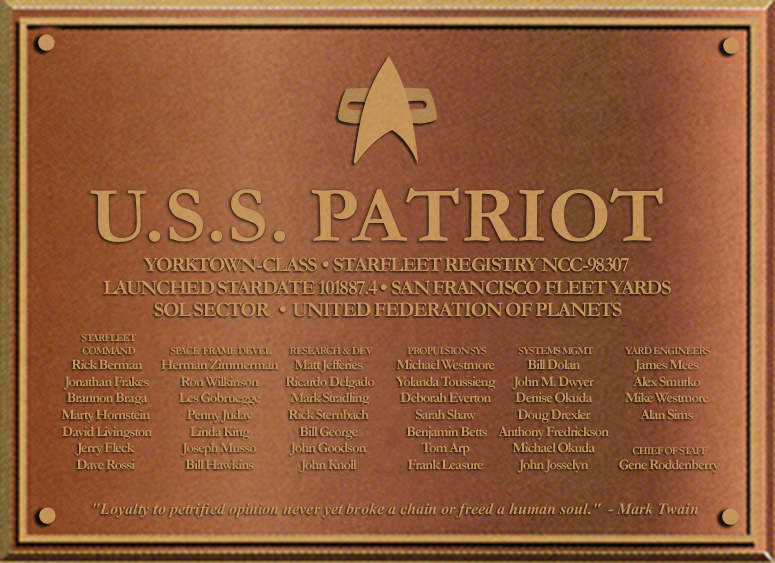
The U.S.S. Patriot (NCC-98307) is a Yorktown Class Dreadnought, operated by the Federation Starfleet, 38th Fleet.
Developed in the aftermath of the Second Battle of Earth, the Yorktown-class was a concerted effort by Starfleet engineers to create a new generation of the Odyssey-class. Designed alongside the Sojourner-class and Endeavour-class, the Yorktown was an update of the Block II/S Odyssey configuration and thus focused on elements necessary to exploration and scientific endeavours.
Legacy
Input previous ships here
Name, and date of service
Brief history here
Service History
Input History here
Technical Data
| Specifications | |
|---|---|
|
Length: Beam: Draft: Mass: |
1041.5 Meters 385.32 Meters 175.62 Meters 7,105,362 Metric Tons |
|
Habitable Decks: Crew Complement: Emergency Cap.: |
43 1,500 15,700 (Evac. Limit) |
|
Avg. Cruising Spd: Max. Cruising Spd: Maximum Spd: |
Warp 8 Warp 9 Warp 9.995 (Non-Slipstream) |
|
Armaments: |
22 Type-XV Phaser Arrays 4 Type-XII Pulse Phaser Cannons 4 Variable Payload Torpedo Tubes (Fore) 2 Variable Payload Torpedo Tubes (Aft) 2x Variable Payload Torpedo Tubes (Aquarius Aft) |
|
Defenses: |
Neutronium Alloy Hull Armour with Ablative Duranium Layer 10 Yoyodyne 1080-D Unified Deflector Field Emitter Arrays JAWS System Active Directional Sensor Matrix |
|
Sensors: |
12x DYN-90 Multi-band Linear Sensor Suites 2x Omniwave Passive Sensor Matrices 2x SENTINEL Omni-Directional Targeting Arrays |
|
Auxiliary Craft: |
10 Type 14 shuttlecraft 5 Type 9 shuttlecraft 4 Type 11 shuttlecraft 6 Type 8 Shuttlecraft 2 Type-11 Shuttlecraft 2 Yellowstone Class Runabouts 20 CMU Workbees 1 Aquarius Class Escort Corvette (U.S.S. Tunny) |
A refit of Odyssey-class hull frames, the Yorktown-class used the same basic arrangement common to most Starfleet ships. It was also the refit design that remained closest in layout to its parent class. The vessel consisted of two hull sections: an oval, domed primary hull and a detachable secondary hull. The forward section of the stardrive hull extended under most of the saucer, retaining most of its length during saucer-separation. Like many designs before it, the two hulls of the Yorktown-class could reattach without returning to spacedock. This ability provided for a great variety in meeting mission needs and in tactical scenarios.
External Layouts
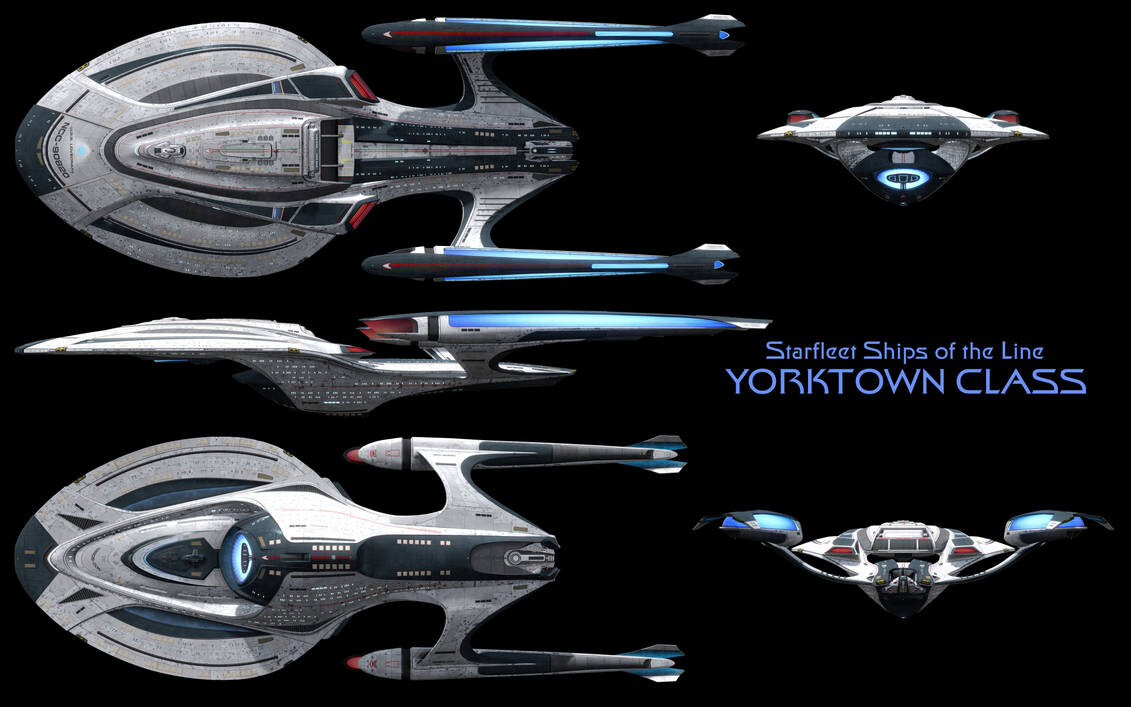 Standard Yorktown Class external views.
Internal Layouts
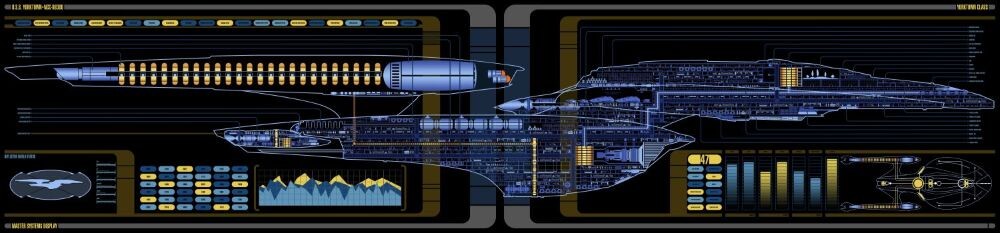 Yorktown Class Master Systems Display
Command & Control Systems
Main Bridge
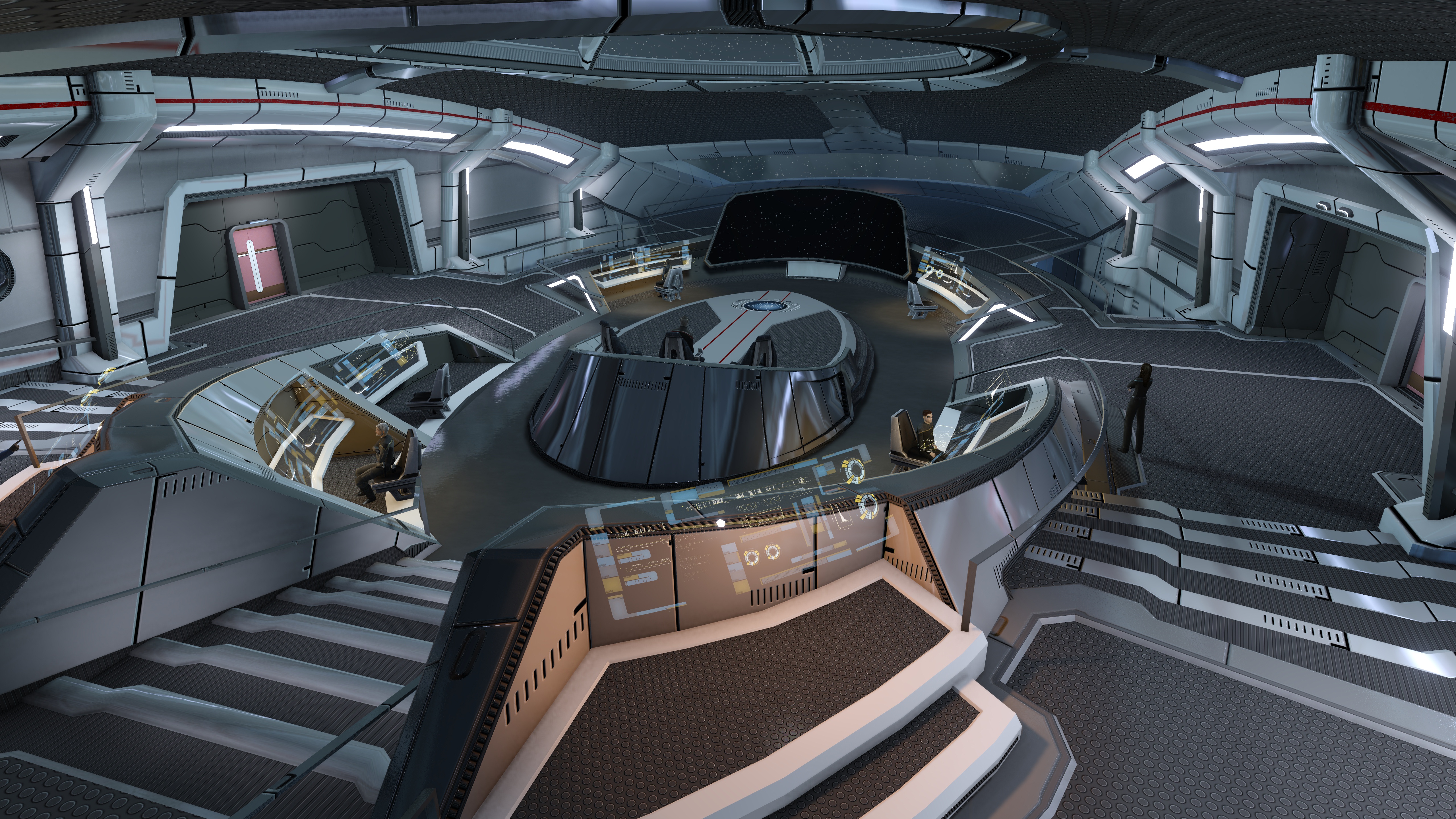
VAR-1 Bridge Module
Auxiliary bridge
Located on Deck 13 in the secondary hull, the auxiliary bridge, sometimes referred to as the “battle bridge,” served as a secondary central command facility if the main bridge was unusable or inaccessible. It also served as the primary command facility of the stardrive section during saucer separation scenarios.
Propulsion systems
Vessels of the Yorktown-class were equipped with one Yoyodyne 47B Matter-Antimatter Reaction Assembly and two Keenser/Pegg Heavy Impulse engines. The primary hull also sported two Inline Flux Secondary Impulse engines for use during saucer separation.
Carrying over from the Odyssey-class design, the Yorktown-class also included an advanced quantum slipstream propulsion system (QSPS). The slipstream tunneling projector was located forward of the navigational deflector on the ventral hull. The system allowed for Yorktown vessels to travel at slipstream speeds exceeding 300 light years per hour for 15 seconds before needing a 2 hour recovery downtime. The dual-neck design connecting the primary and secondary hulls served as waveform attenuators, affording the cruisers improved stability under slipstream.
An Ithra IT-7 Subspace Conduit Access Coil was the core element to the class’ subspace conduit propulsion system (SCPS). This device allowed Yorktown-class starships to connect to the Federation Transwarp Network and jump to gateways within the network at speeds of 360,000 light years per hour. The system had massive power needs, even more than the quantum slipstream drive. To power the coil, starships had to divert energy from weapon and shield systems. Due to strains on the IT-7 coil, it could only be used once every 20 hours.
Science and remote sensing systems
Twelve DYN-90 Multi-band Linear Sensor Suites, four Omniwave Passive Sensor Matrices, and a JAWS Active Directional Sensor Array were the initial standard equipment for the class. The JAWS array was located on the ventral hull behind the berth for the captain’s yacht.
Tactical systems
Like its parent classes, the Yorktown-class is heavily armed and incredibly resilient under enemy fire. The hull was a neutronium alloy reinforced with micro-ablative generators. Based upon technology brought back from the Delta Quadrant by the USS Voyager, these generators helped to dissipate energy across the hull and to regenerate damaged portions of the ablative hull coating.
When developing the Yorktown-class, designers updated the deflector shield systems to the new Yoyodyne 960-B unified field emitter deflector shield arrays. The three equipped arrays projected unimatrix shields with regenerative, multi-spectrum, covariant, and metaphasic properties around the vessels. Nexus Defense Screens, that protected the crew from the effects of the Nexus and similar phenomena, were also integrated into the shield systems.
Vessels of the class mounted 22 Type-XV Annular Confinement Beam-jacketed phaser arrays. The stardrive carried 14 of the arrays, two of which were only usable during saucer separation, with the remaining 8 on the primary hull. Four Type-XII pulse phaser cannons were mounted along the forward edge of the saucer. A total of six Mk 110 variable-payload fixed-mount launch tubes are fitted to the stardrive section. Four of the launchers faced forward, while the remaining two faced aft, with an additional two aft launchers usable when the Aquarius escort is docked, by making use of the Aft launchers on the escort. Quantum torpedoes were carried as standard ordnance, but the class also carried a complement of tricobalt devices for the bombardment of heavy targets.
Auxiliary systems
Including the transporter pad on Deck 1, the Yorktown-class features 11 transporter facilities at strategic locations throughout the ship.
Located aft of the bridge were six compartments for the class’ Modular Rapid Deployment System. Each compartment could be used to quickly deploy probes, mines, and other equipment.
Auxiliary craft systems
Berths
The class carried one specialized berth. This is for an Aquarius-class corvette and is located at the aft of the secondary hull. This berth is designed to allow crews to easily service and refuel the craft.
Present on the Odyssey and other variants, is a berth for the Captain’s Yacht, an auxiliary craft larger than most standard shuttles, but serving a similar purpose.
Shuttlebay
The sole shuttlebay of the Yorktown-Class is situated on the aft rim of the saucer section between the primary impulse engines. The entrance is segmented into three distinct shutters for structural integrity and to allow for streamlined control of craft traffic. Docking control sits above the shuttlebay in a facility that runs most of the width of Deck 3.
A small afterdeck outside the shuttlebay doors could also serve as a landing platform for additional craft, although access to them would require using a transporter or environmental suit.
Auxiliary craft
The initial standard complement of Yorktown starships was an Aquarius-class corvette, a support craft, and 35 other auxiliary craft, including 10 workpods, 8 shuttlepods, 13 shuttlecraft, and 4 runabouts. Actual numbers of craft would vary depending on a starship’s assignment and mission requirements.
Evacuation pods
The Yorktown continues to use the same evacuation pods used in the Odyssey design. The cruisers carry 448 of the Type A Mark IX Autonomous Survival and Recovery Vehicles (ASRV) and 24 of the Type C Mark XII models, for its cetacean crew. Forty-two of the Type A pods are located in the separation plane between the saucer and secondary hull and can only be launched during saucer separation.
Crew Support Systems
Medical facilities
The Yorktown-class vessels contains 6 sickbay wards, four of which were housed on Deck 7 with the office of the chief medical officer. The main sickbay is Class G and the other three on Deck 7 are Class E. The two sickbay wards on Deck 27 in the stardrive section are both Class D.
Holographic projection system
Holographic projectors are equipped throughout Yorktown-class vessels. These allow for emergency holograms to be quickly activated at any location in a time of need. As such, the starship’s computer stores the programs for six Emergency Medical Holograms, six Emergency Engineering Holograms, eighteen Emergency Security Holograms, and an Emergency Command Hologram.
Crew Quarters Systems
Standard Living Quarters: Located on Decks 3-11, these quarters are where the majority of the crew live.
Crew Quarters: Standard Living Quarters are provided for both Starfleet Non-Commissioned Officers, attached civilian personnel and officers holding the rank of Ensign. These persons are expected to share their room with another crewmate due to space restrictions aboard the starship, and after serving aboard the ship for six months, are eligible to bring family aboard and be relocated to Family Quarters.
Two NCOs or two Ensigns are assigned to a suite. A large living area spreads across two bays at the center of the dwelling. Furnished for comfort, it typically holds a personal holographic viewer, couch, two chairs and a work station as well as a standard replicator. This room is flanked on both sides with identical bedrooms, which each take up one bay in length and house room for a double-sized bed and room for personal belongings. A half-bathroom is located on the opposite side from the bedroom’s entrance, and has a sonic shower, wash basin, mirror and several drawers. Provisions for small pets can be made available.
Enlisted crewmembers share quarters with up to four other people of the same gender. A large living area spreads across two bays at the center of the dwelling. Furnished for comfort, it typically holds a personal holographic viewer, couch, two chairs and a work station as well as a standard replicator. This room is flanked on both sides with identical bedrooms, which each take up one bay in length and houses a bunk for two occupants, as well as space for their belongings. A half-bathroom is located on the opposite side from the bedroom’s entrance, and has a sonic shower, wash basin, mirror and several drawers. Pets are not allowed for enlisted crewmen.
Crewmen can request that their living quarters be combined to create a single larger dwelling.
Residential Apartments: Located on Deck 6 and 8-9, these quarters offer more privacy and flexibility for officers, as well as those crew with family onboard. Unlike the standard living quarters, these apartments can be configured to suit the needs of those living in them. Listed below is the base configuration for these living spaces, which can then be tailored by the resident for his needs.
Officers’ Quarters: Starfleet personnel from the rank of Lieutenant Junior Grade up to Commander are given one set of quarters to themselves. In addition, department heads and their first assistant are granted such privileges as well, in an effort to provide a private environment to perform off-duty work. After six months, officers are permitted to bring family aboard the ship and a slightly larger room can be allocated to them. Members of the Senior Staff can have these restrictions waived with the Captain’s permission.
These accommodations typically include a two-bay living area at the center of the dwelling, which usually holds a personal holographic viewer, personal workstation, couch, replicator and a small dining area. Connected to this is a bedroom that occupies one bay and features a double-sized bed and room for personal belongings. Normally, the bedroom is connected by a half-bathroom with wash basin, mirror, several drawers and a sonic shower. This can be upgraded to a full-sized bathroom with a bathtub with permission from the Operations officer as space permits. Provisions can also be made available for pets.
Officers may request that their living quarters be combined to form one larger dwelling.
Executive Quarters: Executive quarters are specially designed to give both the Commanding Officer and Executive Officer added comfort and privacy to perform their duties.
The accommodations are similar to that of the Officer’s Quarters, however, they feature a longer three-bay living area and a full bathroom by default. Slightly more luxurious furniture is also provided, since the Captain often uses this room as an informal meeting area for both private conferencing and reception of guests.
VIP/Diplomatic Guest Quarters: Located on Deck 10 near the shuttlebay, diplomatic quarters are the same as Executive Quarters, but feature private communications terminals for secure conferencing and an additional living area(s) for diplomatic aides. Such facilities on Deck 10 are limited, and in cases involving transport of large numbers of diplomats, VIPs and ambassadors, several areas on Deck 9 can be converted to these standards. In addition, these quarters can be immediately converted to class H, K, L, N, and N2 environments with-in a few hours notice.
Understandably, only a limited number of residential apartments exist aboard a starship. Allocation of available rooms falls under the authority of the Operations Chief, who is then responsible for making arrangements with Engineering and the ship’s Counsellor concerning assignment of personnel.
Recreation Systems
As with any other ship in the fleet, the Patriot features a number of recreational facilities, including holodecks and smaller holosuites, as well as phaser ranges, weight rooms and gyms. There is also a three-screen cinema set up on deck 9 and a swimming pool located on deck 10.
There facilities are spread out across decks 3 to 11, with deck 10 housing a holodeck reserved for any visiting guests or VIPs, however this is often opened to all staff when no guests are on ship.
Personnel
Current Senior Staff

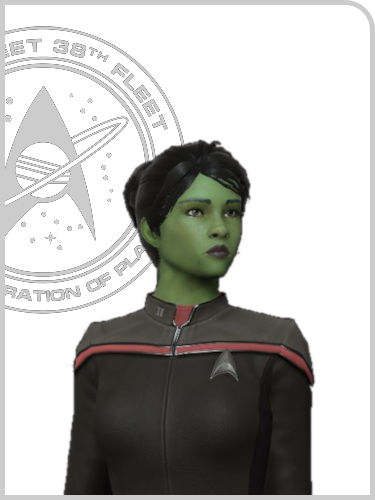
Rank
Name {NPC if not player}
Rank
Name {NPC if not player}
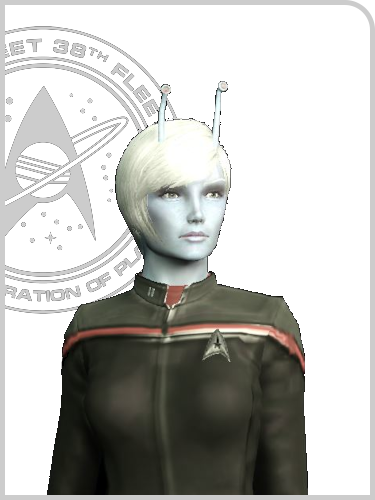
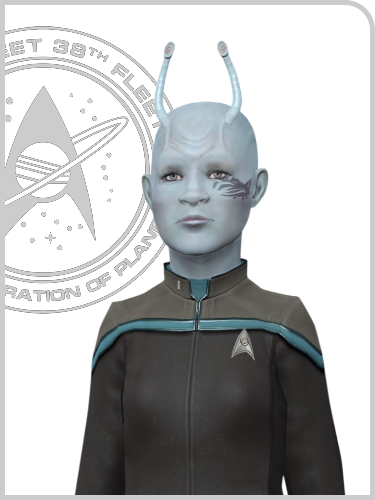
LIEUTENANT
Anakkei Solla
Rank
Name {NPC if not player}
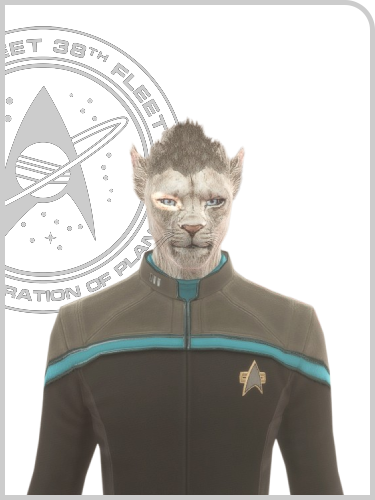
LT Commander
Shamaz Ashydi {NPC if not player}
Rank
Name {NPC if not player}
CUTE
LOTTO
OOC Empty Crew Slots, filled with NPCs as needed, to be replaced with players as they join
Gallery
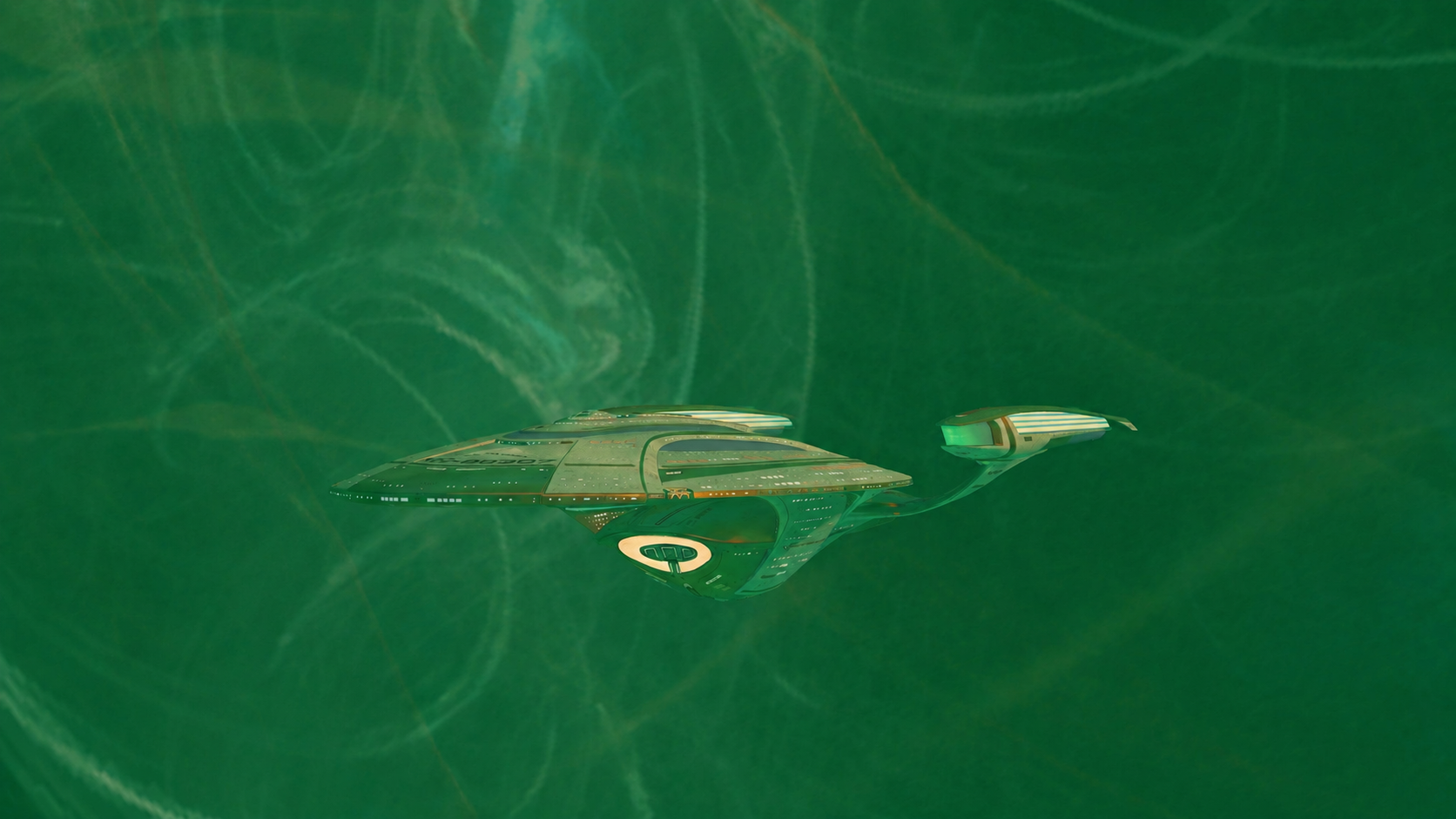
U.S.S. Patriot on a Mission in Fludic Space
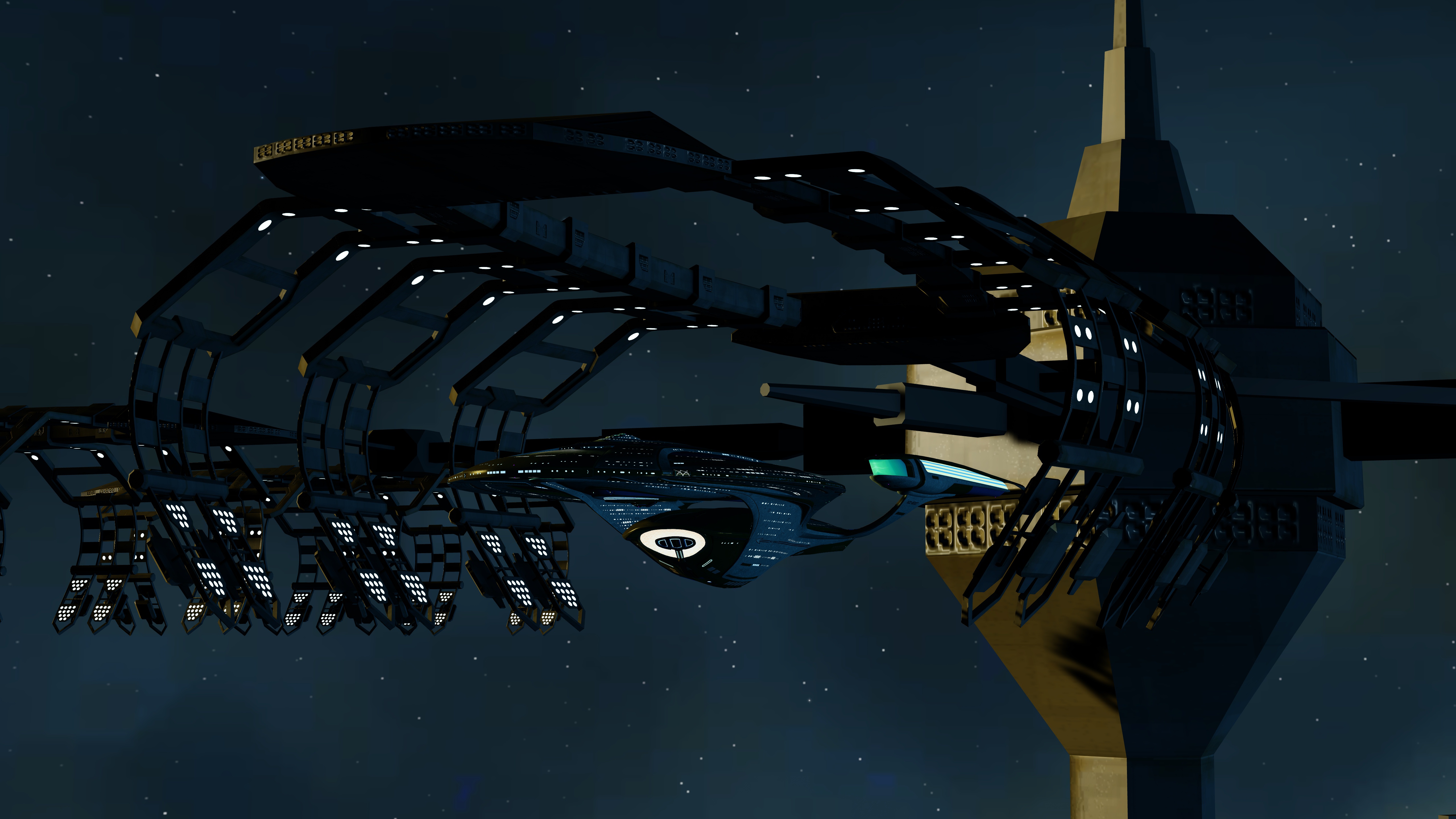
U.S.S. Patriot in dock, near DS-13. following it's assignment to the 38th Fleet
References
- Jayce’s Navy Interstellar - Starfleet’s New Odyssey
- Ktarnfleet Wiki (Odyssey class)
- Ktarnfleet Wiki (Yorktown class)
- Ktarnfleet Wiki (Aquarius class)
- Yorktown class MSD
- Spacedock Video Enterprise, NCC-1701-F Enterprise, NCC-1701-F Information Break Down
- Spacedock Video Yorktown Yorktown Information Break down.