Star System: Trina

STAR SYSTEM: TRINA
KELTERRE SECTOR, BETA QUADRANT

ORBITAL BODIES

S

Trina

Stellar
Mass2.5 Mo Orbit0.1 AU
NOTES Type B (Blue-White) Main Sequence
K

Trina-I

Adaptable
Mass0.09 Me Orbit0.56 AU
D

Asteroid Field

Planetoid
Mass29.25 Me Orbit0.79 AU
M

Trina-II

Terrestrial
Mass11.94 Me Orbit1.24 AU
NOTES Superearth. Gravity of 1.2.
SRS RESULTS Extensive surface and subsurface infrastructure, but very limited clusters of lifesigns.
M

Trina-III

Terrestrial
Mass0.08 Me Orbit2.39 AU
NOTES Pelagic
P

Trina-IV

Ice Giant
Mass9.61 Me Orbit3.37 AU
NOTES Ice Giant
P

Trina-V

Ice Giant
Mass4.35 Me Orbit5.99 AU
NOTES Ice Giant

TRINA PRIME

CLASS M TERRESTRIAL PLANET
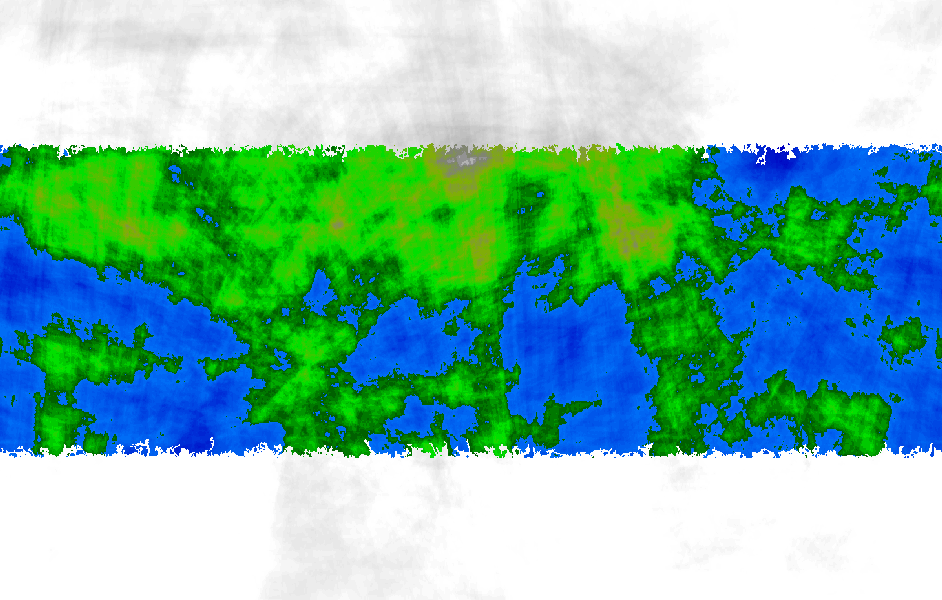
((courtesy of donjon; Fractal World Generator))

POPULATION

~32.6 million

CLIMATE

The habitable band is temperate-to-cold rather than temperate-to-warm, and its equatorial latitudes rarely approach what most warm-adapted species would consider comfortable. Precipitation is heavy and near-constant across most of the inhabited landmass, driven by extensive shelf seas and a fractured, estuary-heavy coastline that keeps moisture in near-permanent circulation. Storm systems are frequent but rarely severe; the more persistent climatic hazard is simply cold, damp, and grey, for most of the year, across most of the world.

GEOGRAPHY

A dominant equatorial-to-mid-latitude landmass, mostly contiguous but heavily fragmented at the edges and leading to significant coastline complexity and variation: deep bays, braided river deltas, archipelagos, flooded lowlands.

–

ASTRONAUTICAL ASSETS

  • 1x massive mobile research starbase (Kali-Sagara)
  • 1x Trina Wormhole Terminus observation outpost (abandoned)
  • 4x fleets of sublight starships, varying sizes and intended crew counts, largely disused and in some amount of disrepair

HISTORY

Trina civilization is ancient, its earliest records treating unification, first flight, and sublight mastery as history layered under tens of thousands of years of continuous development. For much of that time period, the Trinian people thought their solar system was the only one of its kind, as their instruments failed to penetrate the Potter’s Field Anomaly that surrounded them.

Roughly 40,000 years ago, after they had developed sublight travel and had began to thoroughly explore the farther reaches of their star system, they discovered and traveled through the Trina terminus of the Yuhop wormhole for the first time, resulting in a total revolution of their understanding of the galaxy going forward.

Roughly eight thousand years ago, Trinian factions seeking to expand into the greater universe and bring their advanced technological knowledge to other species were effectively exiled when the isolationist factions forcefully closed the Trina wormhole by way of Kali-Sagara station. The isolation that followed did not preserve Trina so much as hollow it out: population and ambition alike have contracted steadily ever since, leaving a system whose assets remain largely intact and largely unused, tended by a people with nothing left to reach for.

STARFLEET FIRST CONTACT, 2425

In 2425, while investigating the potential reasons for the miniscule size increases of the Potter’s Field anomaly, Starfleet discovered the existence of the Trina terminus and, in their attempt to reach it, crash landed a team of personnel on Kali-Sagara’s surface as it actively kept the terminus shut. The team was able to navigate and learn how the station worked sufficiently enough to override the Anchor Protocol, bringing Trina’s roughly almost ~7500 years of isolation to an end.

1 Like

KALI-SAGARA STATION
MASSIVE MOBILE SUPERSTRUCTURE

Specifications
Length:
Beam:
Draft:
Mass:
Surface Area:
Measured Gravity:
140 km
140 km
140 km
~7.18 x 10¹⁴ mt
~61,600 km²
1.2g
Hull Materials:
  • Neutronium (??%)
  • Other components (??%)
Noteworthy Surface Features:
  • 3x Hexagonal Lattice Emitter Arrays — massive hexagonal crystal panels set flush with the surface and facing skyward, arranged in a wide triangle on the hemisphere opposite the impulse engine belt; serve as the primary output for terraforming/wormhole-drive functions in place of a conventional deflector dish
  • Distributed atmospheric emitter grid
    • Responsible for the creation of thin but breathable atmosphere on the surface
  • Distributed Tether System spire grid
    • Emits plasma strikes/beams that allow free navigation of the wormhole. Consists of verteron, tetryon, and graviton particles, as well as some unidentified exotic energy. While the Anchor Protocol is active, also emits a significant quantity of anti-magneton particles.
  • Neutronium dome dwellings in two sizes (12 large, 16 small)
  • Neutronium train rail tracks networked between domes
Climate:
  • Composition/Atmospheric breakdown (0.8 atmospheres)
    • 51% Nitrogen
    • 25% Argon
    • 21% Oxygen
    • 3% Xenon
  • Perpetual snowfall due to temperatures of -1 to 5 degrees celsius.
  • Largely windless.
2 Likes

SUPERSTRUCTURE INFRASTRUCTURE

TRAINS

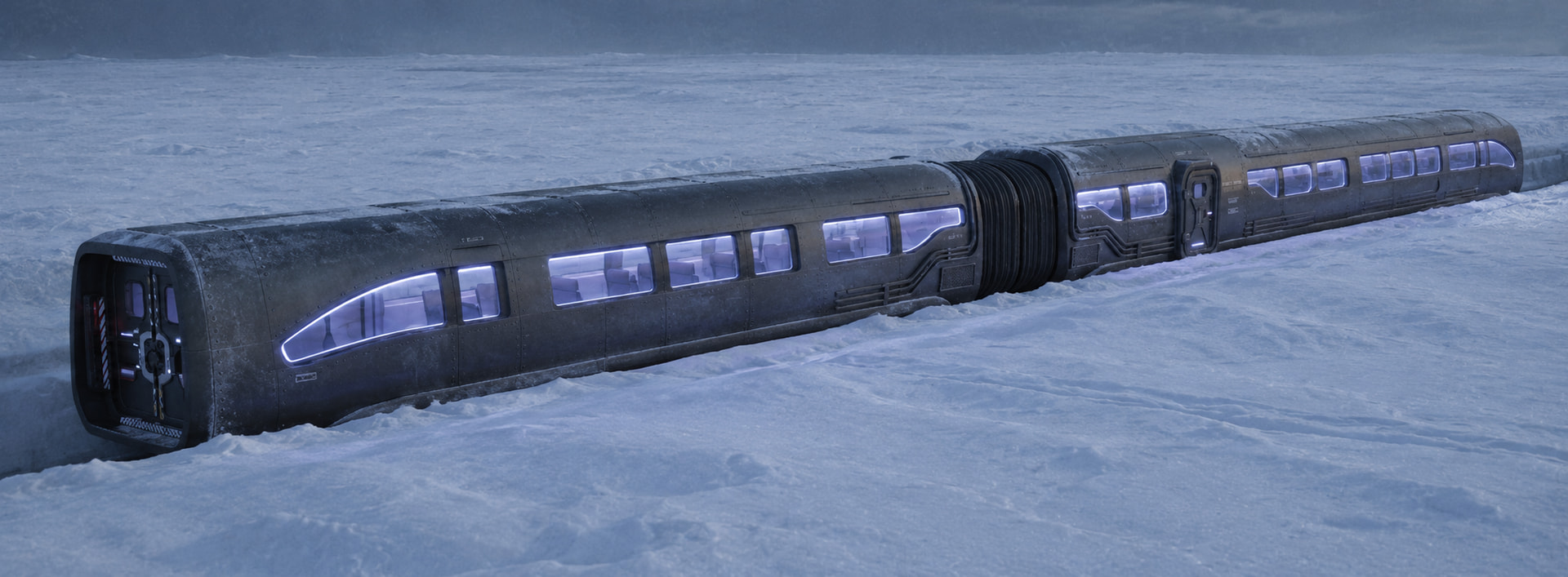
The primary method of transportation for anomaly inhabitants appeared to be by train. A front car side hatch provides access to the housing for the train’s power source (see Superionic Ice Battery below).

TRAIN STATIONS

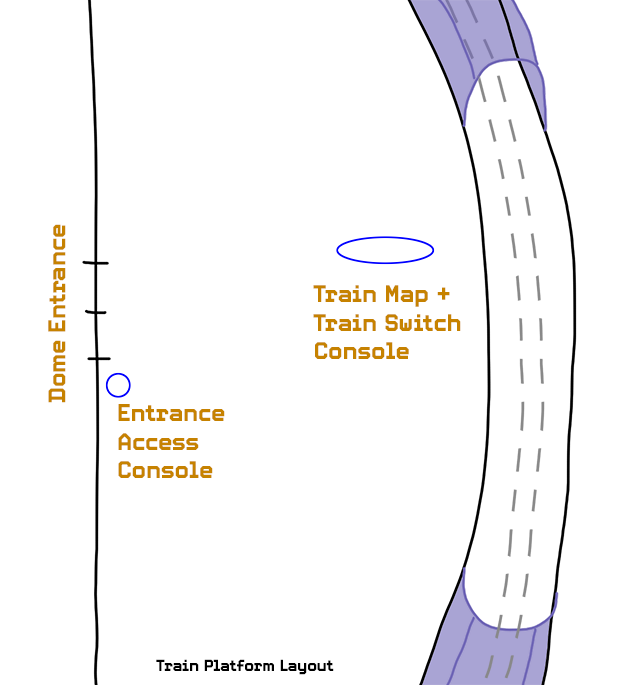
All dome train stations have the following features.

  • The entrance to the main interior of each dome is a double sliding door that typically is unlocked using a handprint bracelet on the Entrance Access Console.
  • Some domes appear to be completely empty and are in a total power down state. These dome entrances are automatically open.
  • The Entrance Access Console is a waist-high neutronium podium with a with a transparent glass/crystalline panel interface. A hand-shaped outline is etched onto the glass’s surface. Trying to use a console without wearing a facility bracelet will result in a red light, while any bracelet will incur a green light and an opening sliding doors.
    • A repair drone permissions chip can also cause the doors to open.
  • The train map console and monitor contains the ability to switch tracks for the local dome.
    • A dome’s power room is located on the -1 floor at the center.
    • If a small dome is empty, no power is flowing into the dome at all, so no terminals work, only dome elevator lifts.

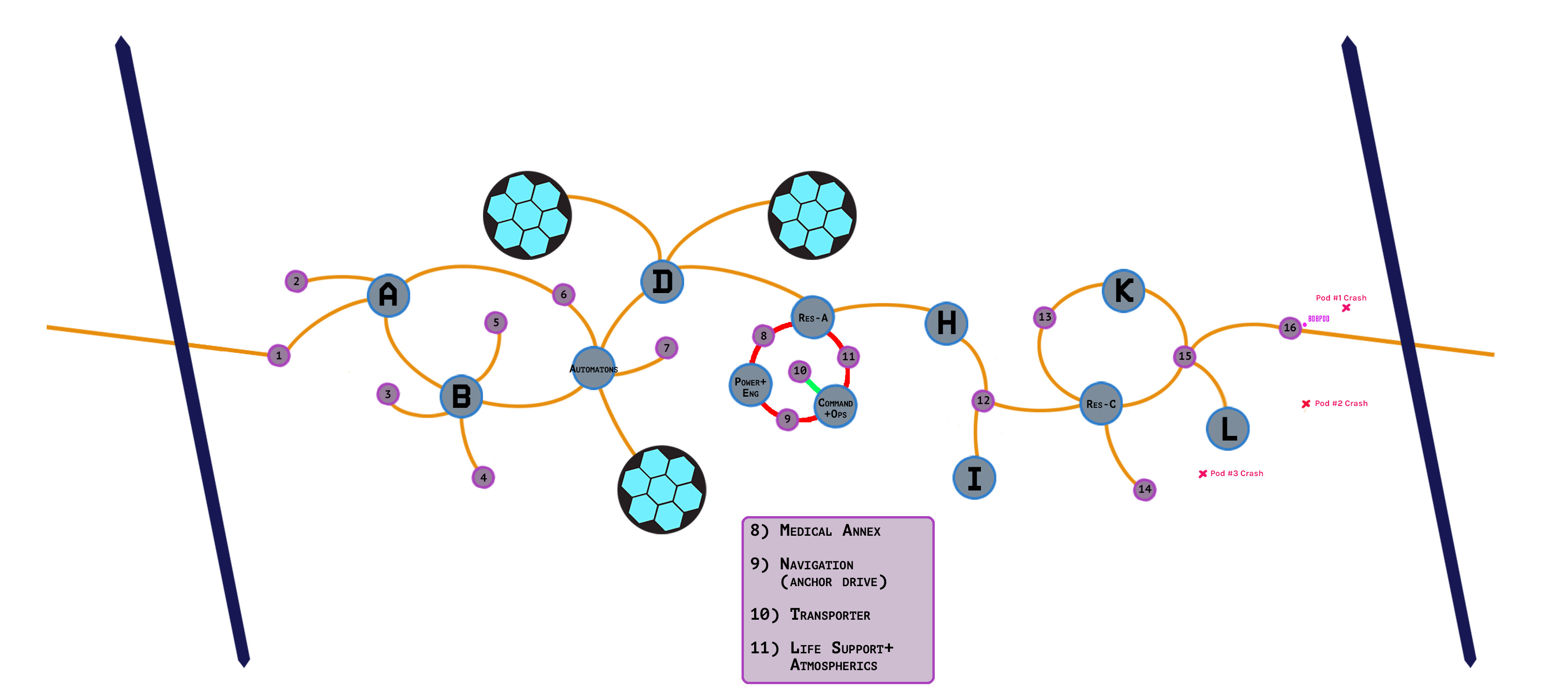
DOME & TRAIN NETWORK MAP

Domes are actually full spheres, with half ‘above’ the dome surface and the other half in levels below. The smaller domes appear to be 6 levels high (and below), while the larger domes are 18 levels high (and below). Elevator columns are available in both sizes and appear to work regardless of the dome’s power mode.

MAP NOTES
  • Station is spherical, so this map wraps around. The dark blue lines are an actual feature on the map, but they are the SAME feature, so this is where the wrap around occurs.
  • While the map does have writing, it’s in alien calligraphy that has not yet been translated. The letters/numbers are for easy human player referencing.

MAP DIRECTORY

  • Hexagon-things: each of these is an enormous 28 km diameter inset into the hull. The inset then contains another seven, hexagonally shaped reflective panels aimed up towards the sky. The panels are a transparent ceramic-crystal composite and extremely hard, and layered with a dense lattice of emitter nodes arranged in various fractal patterns that repeat themselves at every scale. The prevailing theory is that these are the equivalent to a starship’s deflector dish.
  • Askew Meridian: A huge chasm cut into the hull, at the base is a series of huge giant energy coils. Most likely theory at this point is that this entire ‘scar’ is an impulse manifold for sublight engines.
  • A: empty
  • B: [Residential Dome]
  • C: Automatons Control
  • D: [Research Lab]
  • E : Power & Eng
  • F: Residential Dome; higher security level. Contains second, inner train station for closed loop rail line.
  • G: Command+Ops
  • H: [Research Lab]
  • I: [Research Lab]
  • J: [Residential Dome] Contains habitation suites, kitchen, cafeteria, hydroponics facility, medical clinic, and Repair Drone storage/recharging closet.
  • K: [Research Lab] Pocket Dimensions (https://argo.ex-astris.net/t/290-svm-dome-k/5855)
  • L: [Research Lab] Dimensional Folding (https://argo.ex-astris.net/t/873-svm-dome-l/5858)
  • 1: empty
  • 2: empty
  • 3: [Research Lab]
  • 4: [Research Lab]
  • 5: [Research Lab]
  • 6: empty
  • 7
  • 8: Medical Annex
  • 9: Navigation
  • 10: Transporter
  • 11: Life Support+Atmospherics
  • 12: [Research Lab]
  • 13: [Research Lab]
  • 14: [Research Lab]
  • 15: [Research Lab] Matter Phasing (https://argo.ex-astris.net/t/933-svm-dome-15/5852)
  • 16: empty
3 Likes

SUPERIONIC ICE FERG BATTERY?
Power Unit

A sealed power cell, standard housing roughly lantern-sized, built in four concentric layers. The outer shell is a transparent aluminum housing, rigid and inert. Beneath it, filling roughly half the cell’s interior volume, is a thick layer of bioengineered protein gel. Inside that sits a cylindrical Promethium-T lattice, and at the very center, filling the center one-third of volume, an ordinary water ice core.

The gel, typically identified as “FERG” by Starfleet tricorders, generates a steady charge through a self-regulating, enzyme-catalyzed exothermic reaction — consuming depositioned gasses and a water-based protein, producing an equivalent volume and a small electric output as byproducts.

The Promethium-T lattice is a rigid cylindrical scaffold that holds even, sustained pressure against the ice core from all sides once the cell is charged. Under that sustained pressure, the ice core transitions into a superionic state — its oxygen lattice locking solid while hydrogen ions move freely through it as a conductor — and the surrounding gel then sustains that state for as long as the cell holds charge, multiplying the gel’s raw output several-fold over what it could manage unassisted.

A standard cell takes roughly 20 minutes to pressurize and charge, and once charged, the resultant power can efficiently sustain major systems for a long time. Damage to the gel layer, or a fracture in the lattice, lets the core’s held pressure escape all at once: a short, sharp flash, dangerous up close but not a wide-area event. A cell that discharges properly simply reverts to inert gel and ordinary water.

5 Likes

IDENTIFICATION BRACELET
Kali-Sagara Permission System

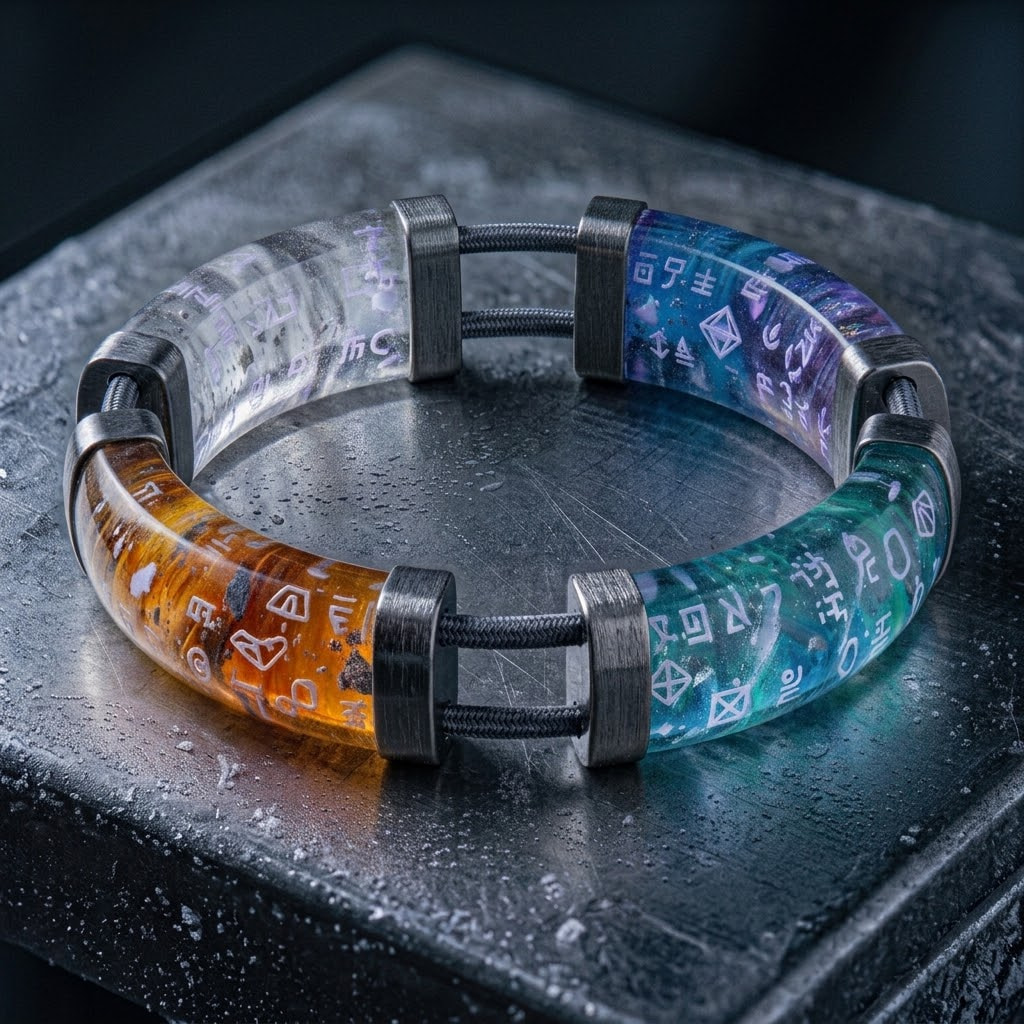
A bracelet with four segments, joined by elastic that allows for the item to stretch when the wearer would like to remove it or put it back on. The primary materials include a strong resin polymer that resists scratches and indentation, with crystalline data fragments suspended within in various patterns, as representations of stored data. The end caps are made of stable promethium, while the braided fiber elastic is waterproof and resists sharp edges.

Bracelets are utilized as the facility’s permissions/access system; as long as a person is wearing a facility-provided bracelet, numerous handprint access consoles will respond to it.

Bracelets are granted by specific consoles that are linked to bracelet replication podiums; these podiums are visually very similar to regular handprint access consoles, only they have an additional hood/alcove structure over the glass panel that materializes the bracelet onto the provided wrist. The facility will only allot an individual 1 bracelet at a time. If one tries to acquire a second, the first one automatically de-materializes.

Each segment functions to encode different information. The clear segment provides a method of communication with all other bracelet wearers. The communication mode is activated by rotating the clear panel it to the wearer’s inside wrist.

It is likely this was developed to allow the original inhabitants to communicate across domes where otherwise the neutronium would interfere with most types of communication efforts.

Another segment functions to encode the wearer’s identity, while a third encodes which project dome the bracelet was acquired at.

3 Likes