
TRINA PRIME
CLASS M TERRESTRIAL PLANET
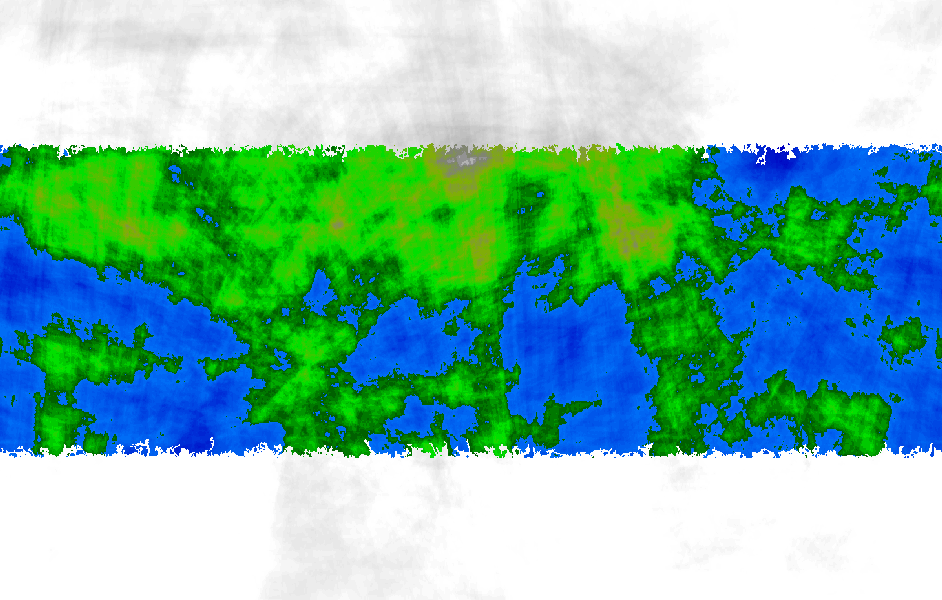
((courtesy of donjon; Fractal World Generator))
POPULATION
~32.6 million
CLIMATE
The habitable band is temperate-to-cold rather than temperate-to-warm, and its equatorial latitudes rarely approach what most warm-adapted species would consider comfortable. Precipitation is heavy and near-constant across most of the inhabited landmass, driven by extensive shelf seas and a fractured, estuary-heavy coastline that keeps moisture in near-permanent circulation. Storm systems are frequent but rarely severe; the more persistent climatic hazard is simply cold, damp, and grey, for most of the year, across most of the world.
GEOGRAPHY
A dominant equatorial-to-mid-latitude landmass, mostly contiguous but heavily fragmented at the edges and leading to significant coastline complexity and variation: deep bays, braided river deltas, archipelagos, flooded lowlands.
–
ASTRONAUTICAL ASSETS
- 1x massive mobile research starbase (Kali-Sagara)
- 1x Trina Wormhole Terminus observation outpost (abandoned)
- 4x fleets of sublight starships, varying sizes and intended crew counts, largely disused and in some amount of disrepair
HISTORY
Trina civilization is ancient, its earliest records treating unification, first flight, and sublight mastery as history layered under tens of thousands of years of continuous development. For much of that time period, the Trinian people thought their solar system was the only one of its kind, as their instruments failed to penetrate the Potter’s Field Anomaly that surrounded them.
Roughly 40,000 years ago, after they had developed sublight travel and had began to thoroughly explore the farther reaches of their star system, they discovered and traveled through the Trina terminus of the Yuhop wormhole for the first time, resulting in a total revolution of their understanding of the galaxy going forward.
Roughly eight thousand years ago, Trinian factions seeking to expand into the greater universe and bring their advanced technological knowledge to other species were effectively exiled when the isolationist factions forcefully closed the Trina wormhole by way of Kali-Sagara station. The isolation that followed did not preserve Trina so much as hollow it out: population and ambition alike have contracted steadily ever since, leaving a system whose assets remain largely intact and largely unused, tended by a people with nothing left to reach for.
STARFLEET FIRST CONTACT, 2425
In 2425, while investigating the potential reasons for the miniscule size increases of the Potter’s Field anomaly, Starfleet discovered the existence of the Trina terminus and, in their attempt to reach it, crash landed a team of personnel on Kali-Sagara’s surface as it actively kept the terminus shut. The team was able to navigate and learn how the station worked sufficiently enough to override the Anchor Protocol, bringing Trina’s roughly almost ~7500 years of isolation to an end.